Supply Chain and Supplier Risk
Decisions That Limit Damage
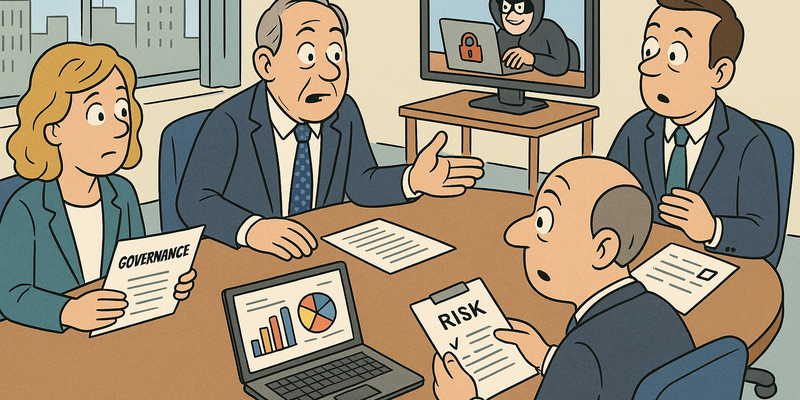
Executive peace of mind comes not from optimism, but from clear accountability and demonstrable follow-through.
For Supply Chain and Supplier Risk, governance only works with measurable goals, clear escalation, and timely decisions.
This way, this topic becomes not a periodic discussion, but a manageable part of regular business operations.
Immediate actions (15 minutes)
Why this matters
The core of Supply Chain and Supplier Risk is risk reduction in practice. Technical context supports the choice of measures, but implementation and embedding are central.
Why is supply chain risk increasing?
Three developments make supplier risk one of the biggest challenges of this moment.
Increasing dependency. Organizations use more and more external software, cloud services, and specialized suppliers. An average mid-sized company has tens to hundreds of suppliers with direct or indirect access to systems or data. Every supplier is a potential entry point.
Scale advantage for attackers. Why attack a thousand organizations separately when you can hit a thousand organizations at once through a supplier? Supply chain attacks are more efficient. An attacker invests once in compromising a supplier and harvests from all their clients.
Trust as a vulnerability. Software updates from a trusted supplier are typically installed without suspicion. That trust is precisely what attackers exploit. The malicious code enters through a channel that is explicitly considered safe.
Types of supply chain risk
Supply chain risk is broader than just hacked software. It helps to know the different types, so you know where to look.
| Type | What it involves | Example |
|---|---|---|
| Software supply chain | Malicious code in software updates, libraries, or open-source components. See also CI/CD pipeline hardening for the technical side of this risk | SolarWinds (malicious update of network management tool), Log4j (vulnerability in widely used open-source library) |
| Service providers | Suppliers with access to your network or data are compromised | IT administrator with admin rights on your systems gets hacked, MSP as a stepping stone to clients (Kaseya) |
| Cloud services | Vulnerabilities or configuration errors at your cloud provider affect your data | Data breach at a SaaS vendor, insecure default settings in cloud environments |
| Hardware | Compromised hardware or firmware that already contains a backdoor at delivery | Manipulated network equipment, chips with built-in vulnerabilities |
| Data processing | Suppliers that process your (customer) data and have insufficient security | MOVEit (file exchange platform), payroll processor with data breach |
Insight: The most underestimated risk is often with indirect suppliers -- the suppliers of your suppliers. You have a contract with party A, but party A outsources work to party B, which in turn uses a cloud service from party C. Do you have visibility into that entire chain?
Assessing supplier risk
You don't need to be a security expert to ask the right questions. A structured assessment of your suppliers starts with understanding what you entrust to them and how they handle it.
The five key questions
What data or systems does this supplier have access to? The more sensitive the data and the broader the access, the higher the risk.
How is the supplier's security organized? Do they have an information security policy? Are they independently audited? Do they have relevant certifications?
What happens if the supplier gets hacked? Does the supplier have an incident response plan? How quickly are you informed as a client? What are the contractual agreements on this?
How does the supplier manage their own suppliers? Supply chain risk is a chain. If your supplier doesn't assess their own sub-suppliers, you have a blind spot.
What is the exit plan? Can you switch to another supplier if things go wrong? Or are you locked in with an irreplaceable party?
Contractual security requirements
Good agreements on paper do not replace good security, but they do give you a basis to set requirements, verify compliance, and -- if things go wrong -- establish responsibilities.
What should be in a supplier contract at minimum?
| Topic | What you include | Why it matters |
|---|---|---|
| Security standards | Supplier complies with ISO 27001, SOC 2, or a comparable framework | Provides a baseline for the security level |
| Incident reporting obligation | Supplier reports security incidents within an agreed timeframe (e.g., 24 hours) | Without prompt reporting, you cannot respond in time and cannot meet your own reporting obligations |
| Audit rights | You have the right to audit (or have a third party audit) the supplier's security | Trust is good, verification is necessary |
| Sub-processors | Supplier informs you about and seeks approval for engaging sub-suppliers | Prevents your data from ending up with unknown parties |
| Data processing | A data processing agreement in accordance with the GDPR describing what data is processed, for what purpose, and for how long | Legally required when a supplier processes personal data on your behalf |
| Exit and data retention | Agreements on return or destruction of data upon contract termination | Prevents your data from lingering with the supplier after the relationship ends |
| Liability | Clear agreements on liability in case of a security incident | Prevents endless discussions at the worst possible moment |
Practical tip: Many standard supplier contracts contain clauses that maximally limit their own liability. Always have contracts with critical suppliers reviewed legally with specific attention to cybersecurity provisions.
NIS2 and the supply chain obligation
The European NIS2 directive, which is being implemented in the Netherlands through the Cybersecurity Act, explicitly sets requirements for supply chain risk management. This is not voluntary -- it is a legal obligation for organizations that fall under the directive.
What NIS2 requires:
- Organizations must assess and manage cybersecurity risks in their supply chain
- This includes direct suppliers and critical service providers
- Security requirements must be contractually established
- Organizations must take into account the specific vulnerabilities of each supplier
- There must be attention to the quality of products and the cybersecurity practices of suppliers
What this means in practice for executives:
Supply chain risk management is no longer something you "should do" -- it is something you must do. Regulators can enforce compliance, and in the event of an incident, it will be assessed whether you demonstrably fulfilled your duty of care. "We trusted our supplier" is no longer a defense.
Categorizing suppliers by risk level
Not every supplier deserves the same level of attention. An office plant supplier has a different risk profile than your cloud hosting partner. By categorizing suppliers into risk levels, you can focus your limited time and resources where it matters most.
| Tier | Criteria | Examples | Assessment frequency | Measures |
|---|---|---|---|---|
| Tier 1 -- Critical | Direct access to your network or sensitive data, business-critical services, difficult to replace | Cloud hosting provider, IT management company, ERP vendor, payroll processor | Annual audit or assessment, continuous monitoring | Comprehensive contractual requirements, regular audits, joint incident response exercises, exit plan |
| Tier 2 -- Significant | Limited access to systems or data, important but not business-critical, replaceable with effort | SaaS applications, communication platforms, external consultants with system access | Annual questionnaire, periodic review | Contractual security requirements, certification requirement, annual assessment |
| Tier 3 -- Low | No direct access to systems or sensitive data, easily replaceable | Office supplies, cleaning company (unless they have physical access to server rooms), marketing agency without data access | One-time assessment at contract signing, review at contract renewal | Standard procurement terms with basic security clauses |
Note: The categorization is not static. A supplier can change tiers when the relationship changes -- for example, when a marketing agency gains access to customer data for a campaign. Review the categorization at least annually.
Monitoring and auditing suppliers
An assessment at contract signing is a starting point, not an endpoint. Suppliers change. Their security can deteriorate. Their personnel changes. They get acquired by another party. Therefore, ongoing oversight is necessary.
Methods for supplier monitoring
| Method | What it provides | Effort | Suitable for |
|---|---|---|---|
| Questionnaire (self-assessment) | Insight into the supplier's security policy and measures, based on their own declaration | Low | All tiers, annually |
| Certification requirement (ISO 27001, SOC 2) | Independent confirmation that the supplier meets a recognized security framework | Low (for you) | Tier 1 and 2 |
| Independent audit (third-party assessment) | In-depth review by an independent party | High | Tier 1, for critical suppliers |
| Continuous monitoring platform | Automated monitoring of the external security posture of suppliers (e.g., SecurityScorecard, BitSight) | Medium (one-time setup) | Tier 1 and 2, ongoing |
| Request pentest reports | Insight into the results of security tests conducted by the supplier | Low | Tier 1 |
| Discuss incident history | Understanding of how the supplier handles incidents and what has occurred in the past | Low | Tier 1 and 2, annually |
Practical checklist: supplier assessment
Use this checklist when assessing new and existing critical suppliers.
| Topic | Question for the supplier | Expected answer |
|---|---|---|
| Certification | Do you hold an ISO 27001 certification or SOC 2 report? | Yes, with a valid certificate or report |
| Access management | How do you manage your employees' access to our data and systems? | Role-based access, principle of least privilege, MFA |
| Incident response | Do you have an incident response plan and how quickly do you report incidents to clients? | Documented plan, notification within 24 hours |
| Data security | How is our data encrypted, stored, and deleted after contract termination? | Encryption at rest and in transit, documented retention and destruction policy |
| Sub-processors | Do you engage third parties that gain access to our data? | Transparent overview, prior approval required |
| Continuity | What is your business continuity plan in case of a cyber incident? | Documented plan with recovery times (RTO/RPO) |
| Personnel | How do you screen and train employees who work with client data? | Background checks, periodic security awareness training |
| Patch policy | How quickly are critical security updates applied? | Critical patches within 24-48 hours, documented patch policy |
| Penetration tests | Do you regularly have penetration tests performed and can you share the results? | At least annually, willingness to share (summary of) results |
| Insurance | Do you have cyber insurance? | Yes, with adequate coverage |
Practical tip: A supplier that refuses to answer security questions or cannot show certification is a red flag. Good suppliers understand that clients ask these questions and have their answers ready. Resistance to transparency is rarely a good sign.
What to do in case of a supply chain incident
When a supplier is compromised, speed is essential. You must do two things simultaneously: limit the damage to your own organization and manage communication with the supplier and your own stakeholders.
Immediate actions:
- Assess the impact -- which systems and data are potentially affected through this supplier?
- Restrict access -- disconnect the supplier from your network or limit their access rights until the situation is clear
- Activate your incident response process -- treat it as your own incident (see chapter 7)
- Communicate with the supplier -- demand clarity about the nature and scope of the incident, the measures taken, and the expected timeline for recovery
- Assess your reporting obligations -- if personal data is affected, your own reporting obligations to the Data Protection Authority apply
- Document everything -- for potential legal proceedings, insurance claims, and the post-incident evaluation
Summary
Supply chain risk is one of the most underestimated threats to organizations. Your own security may be excellent, but if a critical supplier is compromised, it affects you directly. The key lessons:
- Your security is only as strong as your weakest supplier -- map out which suppliers have access to your systems and data
- Not all suppliers are equal -- categorize them by risk level and focus your attention on the critical parties
- Ask the right questions -- you don't need to be a technician to assess a supplier. The five key questions give you a solid foundation
- Put it in contracts -- security requirements, reporting obligations, audit rights, and liability belong in every supplier contract
- NIS2 makes it mandatory -- supply chain risk management is a legal obligation, not a recommendation
- Monitor continuously -- an assessment at contract signing is a start, not an endpoint. Suppliers change, and your oversight must keep pace
- Prepare for the inevitable -- the question is not if one of your suppliers will ever be compromised, but when. Make sure you know what to do when it happens
The bottom line: You can outsource security, but you cannot outsource responsibility. When a supplier gets hacked and your customer data ends up on the street, the regulator does not look at your supplier. They look at you.
Further reading
A supply chain incident brings not only operational damage -- it can also have significant financial consequences, from forensic investigation to legal costs and revenue loss. How you can manage those financial risks and what cyber insurance does and does not cover, you can read in the next chapter: Cyber Insurance.
Do this this month
| Topic | Yes/No | Action needed |
|---|---|---|
| You have a current overview of all suppliers with access to your systems or data | ||
| Suppliers are categorized by risk level (Tier 1, 2, 3) | ||
| Contracts with Tier 1 suppliers contain security requirements, reporting obligations, and audit rights | ||
| A data processing agreement has been concluded with every supplier that processes personal data | ||
| Tier 1 suppliers have been assessed on their security in the past year | ||
| There is an exit plan for every critical supplier | ||
| Supply chain risk management complies with NIS2 requirements (if applicable) | ||
| There is a procedure for disconnecting a compromised supplier |
Further reading in the knowledge base
These articles in the portal provide more background and practical context:
- Compliance — following rules without losing your mind
- Incident Response — when things go wrong
- Supply chain attacks — the weakest link problem
- "Are we a target?"
- Ransomware — digital hostage-taking for beginners and advanced users
You need an account to access the knowledge base. Log in or register.
Related security measures
These articles provide additional context and depth: